|
Environmental crowdsourcing / Participatory observation of biodiversity / Environmental education through practice / Social innovation and co-innovation / Participatory ecological transition / Non-anthropocentric approach
1. Why participatory science has become central to ecological transitions
The ecological transition requires responding simultaneously to several crises: climate change, biodiversity collapse, chemical pollution, the scarcity or degradation of water resources, ocean acidification, soil artificialization, disruption of biochemical cycles, habitat fragmentation, loss of connection with nature, and the difficulty of changing collective behaviors.
These crises have three characteristics that make participatory science particularly relevant.
First, they are systemic. They are never limited to a single symptom. A polluted river is not only a problem of water quality; it points to agricultural, industrial, domestic, urban, political, and economic practices. A decline in biodiversity is not only the disappearance of species; it points to pesticides, habitat fragmentation, climate change, land use, ecological corridors, planning policies, and cultural representations of the living world.
Second, they are territorial. Even when they are planetary, they always manifest somewhere: in a street that is too hot in summer, a river where microplastics appear, a paved schoolyard, a forgotten wetland, a treated agricultural field, a beach where shellfish are changing, a fragmented forest, a neighborhood lacking trees, a territory where residents no longer know which species are still present.
Third, they are political. Data are not enough if they change nothing. But public decisions often lack fine-grained, local, continuous, readable, and socially appropriated data. Participatory science then creates a bridge between knowledge and action.
"By strengthening citizens’ capacity to act, participatory science enables them to reclaim their territory and have a direct impact on local policies."
It can even confront decision-makers with a new reality: when citizens have already observed, measured, mapped, documented, and sometimes tested solutions, it becomes more difficult to reply that action is impossible.
2. From awareness-raising to research: what participatory science really changes
Three levels that are often confused must be distinguished.
1. Environmental awareness-raising.
It aims to inform, move, explain, or convince. It is useful, but it often remains top-down: someone who knows transmits to someone who learns.
2. Scientific or ecological education.
It makes it possible to learn through experience, for example by observing species, understanding a natural cycle, studying an environment, discovering the effects of a pesticide, or carrying out a measurement in the field. It is essential for changing representations and skills, especially among young people.
3. Participatory science.
It truly begins when citizens are no longer merely recipients of knowledge, but participate in the production of knowledge. They can help define the question, collect data, choose methods, discuss results, produce interpretations, formulate recommendations, communicate conclusions, and sometimes decide on the actions that follow.
"Participatory science means that citizens conduct research, take part in decisions, analyze results, and communicate lessons learned. They do not merely learn."
This distinction is decisive. A group of students studying pesticides in a field may experience an excellent educational activity. But the project becomes truly participatory if the students, teachers, researchers, farmers, or residents also participate in formulating the question, choosing the protocol, comparing sites, analyzing results, and discussing the consequences.
Example:
A class learning what an insect is: scientific education.
A class observing insects in several fields: education through practice.
A class contributing to a protocol comparing organic, conventional, or differently managed fields, with Barber traps, data that can be used by researchers, and a discussion on agricultural practices: participatory science.
An approach that then helps guide agricultural practices, local decisions, or pesticide reduction policies: participatory science with impact.
3. Planetary boundaries as a starting framework
One working session took the planetary boundaries as its starting point, as defined by scientists and taken up from 2009 onward by the Stockholm Resilience Center. The central idea is simple: there are thresholds within which the pressure exerted by human activities remains bearable for the functioning of the Earth system. The further humanity moves away from this sustainable zone, the more it enters a zone of overshoot where effects become difficult to predict and may become irreversible.
The nine boundaries mentioned include:
climate change;
biodiversity erosion;
ocean acidification;
chemical pollution;
disruption of biochemical cycles;
water resources and water quality;
land-use change and soil transformation;
the ozone layer;
aerosols.
During the exercise, it was recalled that several boundaries have already been crossed. The discussion indicated that seven out of nine boundaries are currently in overshoot, while some, such as the ozone layer and aerosols, were set aside in the educational framework of the workshop, either because they were not considered priorities for the exercise, or because they did not make it possible to form teams within the allotted time.
Suggested illustration: target diagram: in the center, sustainable zone; around it, overshoot zones; arrows pointing outward showing the increase in risk.
The exercise was not about solving the nine boundaries all at once. On the contrary, it was about learning how to make choices. The group had to select between five and seven priority boundaries, according to two criteria:
the level of urgency: which boundaries have already been crossed or are particularly critical?
the leverage effect: which boundaries, if better addressed, can facilitate the resolution of other boundaries?
This notion of leverage effect is essential. When it is not possible to act on everything at the same time, it is necessary to identify the points of action capable of producing other positive effects.
Example:
protecting a habitat can protect several species;
protecting a keystone species can lead to the protection of an entire ecosystem;
restoring a wetland can improve water, biodiversity, the local climate, and resilience to droughts;
transforming a paved schoolyard into a vegetated space can act simultaneously on heat islands, water infiltration, children’s education, nearby biodiversity, and quality of life.
At the end of the prioritization process, five boundaries were selected for the exercise:
climate change;
biodiversity erosion;
chemical pollution;
water resources;
ocean acidification.
The choice was also discussed in terms of role distribution: at the intergovernmental level or within an ecosystem of organizations, all boundaries must be addressed; but an organization or project group may choose to address some of them, with a coherent logic, knowing that other actors will work on other boundaries.
4. Acting on symptoms or acting on causes?
One of the most important educational points in the workshops concerns the difference between impact on symptoms and impact on causes.
A symptom is what we see. A cause is what produces what we see.
"If there is smoke, the smoke is the symptom. The cause may be the fire. Acting on the smoke is not enough if the fire continues."
This distinction is fundamental for ecological transitions. Many actions are useful because they reduce immediate effects. But they do not necessarily transform the mechanisms that produce the problem.
Examples:
Distributing water during a heatwave acts on a symptom; sustainably greening the hottest streets acts more on a local cause of heat islands.
Collecting waste from a river acts on a symptom; reducing the production, use, or leakage of plastics acts on a cause.
Measuring water consumption acts on knowledge of the symptom; transforming uses, equipment, urban practices, or impermeable surfaces acts more deeply on the causes.
Responding to forced migration may be a necessary emergency response; acting on the causes of migration, such as environmental or economic degradation, belongs to another level of action.
Participatory science must therefore not only ask: what can be observed? It must also ask: what can this observation be used for? and above all: what change becomes possible thanks to this observation?
"Who wants to know what, in order to do what with it?"
This sentence summarizes a major methodological requirement. A participatory project with impact must clarify:
who asks the question;
who needs the answer;
who collects the data;
who analyzes them;
who can act afterward;
what change is targeted;
at what scale this change can occur;
how the impact will be evaluated.
5. The board game: learning to design projects with impact
To make this distinction concrete, participants experienced an educational board game. The floor became a checkerboard. Each team had to propose, within a short time, a participatory science action in response to a planetary boundary.
The exercise was intentionally fast. The teams had about two minutes to think, then had to present their proposal in thirty seconds or one minute. The other participants then voted on the level of impact.
The three evaluation levels were as follows:
No significant impact: the proposal is interesting, but it does not seem to produce real change. The team moves diagonally to the left.
Impact on symptoms: the proposal helps observe, reduce, or manage a consequence of the problem. The team moves forward two squares.
Systemic impact on causes: the proposal acts more deeply on the mechanisms that produce the problem. The team moves diagonally to the right.
The symbolic objective was to reach an area called Eden, or the new Eden, representing collective success: humanity gets out of the rut and returns to a sustainable trajectory.
The game was neither a classic competition nor a simple cooperative game. It was described as a form of coopetition: all teams must succeed, because everyone must emerge from the ecological crisis; but participants must not go easy on one another in the evaluation. Kindness does not exclude rigor.
"We are kind, but we are categorical. If there is no impact, there is no impact. If it is an impact on symptoms, it is an impact on symptoms. If it is systemic, then congratulations."
This requirement is valuable: it avoids too quickly calling an action a "solution" when it does not really change the situation. It forces projects to mature.
6. The five challenges proposed to the teams
The five teams worked on concrete challenges, each linked to a planetary boundary.
Challenge 1 - Climate change and urban heat islands
In a city of 100,000 inhabitants, no one knows which streets are the hottest in summer. How can citizens measure and map heat islands to help the city plant trees in the right places?
Challenge 2 - Biodiversity erosion
In a region, no one knows which species are actually disappearing. How can a citizen inventory of local biodiversity be organized?
Challenge 3 - Water resources
A city does not know which areas consume the most water. How can citizens help measure uses?
Challenge 4 - Ocean acidification
Fishers observe changes in shellfish. How can citizens monitor water acidity?
Challenge 5 - Chemical pollution and microplastics
No one knows how many microplastics are found in local rivers. How can citizens measure them?
These challenges intentionally contained traps. A proposal could be participatory but without systemic impact; educational but not truly participatory; local but difficult to connect to global causes; scientifically interesting but not very transformative; or potentially useful but insufficiently connected to decisions.
7. First round: useful proposals, but often still focused on symptoms
7.1. Water resources: the light-up showerhead
A first team proposed a light-up showerhead device that would make it possible to visualize water consumption in real time. The light would gradually change from green to pink, then to red after a certain time, for example five minutes. The idea is that abstract figures do not always speak to people, whereas an immediate visual signal can trigger awareness.
Value:
making invisible consumption visible;
acting at the very moment of the behavior;
producing simple and understandable feedback;
enabling a change in daily use.
Limit:
The proposal mainly acts on individual behavior and on the symptom of consumption, without necessarily transforming the structural causes of water consumption in the city, housing, equipment, collective uses, or planning choices.
7.2. Biodiversity: the citizen inventory through a notebook or calendar
One team proposed a local biodiversity observation campaign, inspired by inventory approaches. Residents would use a notebook, calendar, or monitoring tool to record the species present, those appearing, those becoming rare, or those disappearing.
Value:
multiplying observations;
producing local mapping;
involving residents in knowledge of the territory;
better understanding the evolution of biodiversity.
Limit:
The inventory produces knowledge, but it does not in itself guarantee systemic change. It becomes more powerful if it is connected to decisions: ecological corridors, habitat protection, habitat restoration, changes in agricultural or urban practices.
7.3. Climate change: mapping heat islands
One team proposed mobilizing the residents of a city to measure the hottest streets during heatwaves. Citizens could record temperatures, produce a map of heat islands, and help the local authority decide where to plant trees.
Value:
producing very concrete local data;
helping prioritize intervention areas;
connecting climate, urban planning, health, and quality of life;
making residents actors in a visible transformation.
Limit:
Mapping alone mainly acts on knowledge of the symptom. The impact becomes more systemic if it triggers a policy of greening, depaving, changing surface materials, reducing mineral surfaces, and durably transforming urban choices.
7.4. Microplastics: measurement kits and bioindicators
One team proposed a large-scale awareness campaign with the distribution of kits to measure or detect microplastics in rivers, as well as the use of bioindicators, particularly aquatic organisms likely to reveal the presence or effects of pollution.
Value:
making barely perceptible pollution visible;
raising awareness on a large scale;
producing local data;
connecting chemical pollution, water, biodiversity, and health.
Limit:
Measuring microplastics first acts on knowledge and awareness. The action becomes more systemic if it makes it possible to identify sources of pollution and intervene on plastic uses, discharges, sectors, and industrial, agricultural, or domestic practices.
7.5. Ocean acidification: restoring marine carbon sinks
One team connected ocean acidification to carbon emissions and the degradation of coastal environments. It proposed restoring marine or coastal carbon sinks: seagrass beds, mangroves, coral reefs, coastal areas, corals more resistant to temperature hazards.
Value:
connecting climate, ocean, biodiversity, and carbon;
acting on environments capable of storing carbon;
restoring ecosystems useful for resilience;
going further than simply measuring acidity.
Limit:
The proposal becomes strong if it truly integrates citizens into research, monitoring, restoration, evaluation, and local governance. Otherwise, it risks becoming a conventional ecological restoration project, without a sufficiently clear participatory dimension.
8. Second round: the proposals mature
The second round made it possible to make the proposals more complex and to better distinguish between simply educational projects, measurement projects, direct change projects, and truly participatory projects.
8.1. Fine particles: a citizen sensor network
One proposal focused on air pollution from fine particles. The idea was to place sensors near major sources, for example factory exits, chimneys, roads, or traffic areas, in order to identify pollution peaks and the most exposed areas.
Scientific contribution:
production of fine-grained data;
measurement in several locations;
identification of peaks;
comparison with potential sources;
documentation of a local problem.
Question of impact:
The effect remains limited if the measurement changes nothing about emissions. The project gains power if it leads to decisions: limiting certain emissions, changing traffic flows, industrial transformation, citizen oversight, dialogue with public authorities, or changing the practices responsible for fine particles.
8.2. Agricultural methane: a proposal judged insufficiently participatory
Another proposal concerned agricultural methane emissions. It raised the idea of calling on farmers and finding solutions to reduce emissions linked to certain practices. Options such as conditionality of aid or transformation of sectors were mentioned.
But the debate showed an essential limit: a proposal can concern field actors without necessarily being participatory science. If farmers are only "concerned," "targeted," or "made aware," the project is not necessarily participatory.
To become participatory, farmers, citizens, researchers, and other stakeholders would need to:
co-define the questions;
choose the experiments;
contribute to observations;
analyze the results;
compare practices;
communicate lessons learned;
participate in decisions about change.
8.3. Pesticides and insects: Barber traps and comparison of agricultural practices
One proposal involved students in examining the impact of pesticides on insect fauna. The idea was to compare different sites: an organic field, a field using pesticides, a differently managed field, or several types of agricultural practices. Barber traps would make it possible to capture and study certain insects in order to compare species richness or diversity according to practices.
Strengths:
a visual and concrete activity for students;
comparison of sites;
production of usable data;
direct link between agricultural practices, biodiversity, food, and the environment;
possibility of feeding into scientific studies and agricultural recommendations.
Points of vigilance:
the protocol must be ethical and appropriate;
students must not merely "help" scientists, but understand and participate in the process;
the project must connect observation, food, agricultural practices, and decisions;
the impact can be educational in the short term, scientific in the medium term, and behavioral or political in the long term.
8.4. Water resources: mapping wetlands and depaving
The most systemic proposal of the second round concerned the reduction in freshwater sources. A first avenue consisted of mapping wetlands. But the team then shifted the thinking toward the causes: soil impermeabilization.
Citizens could identify concreted or asphalted areas that could become permeable again. The example of a schoolyard was mentioned: instead of a fully mineral surface, it could be vegetated, tree-planted, cooler, more permeable, more favorable to water infiltration and biodiversity.
In this approach, citizens, parents of students, neighbors, children, and elected officials do not merely report a problem. They:
map;
analyze;
choose priority areas;
discuss possible transformations;
carry the request;
participate in the decision;
monitor the effects.
This approach shifts part of what is usually entrusted to consulting firms toward research and action co-constructed with citizens, while maintaining the requirement for methodological rigor.
This is a key example of participatory science with systemic impact: measurement leads to a physical transformation of the territory, which can regenerate water resources, improve biodiversity, reduce heat islands, and strengthen local capacity to act.
9. The global/local dilemma: are local citizen actions enough?
One participant raised an important methodological bias: ecological crises are global, systemic, and planetary, while many citizen proposals remain local. The risk is to suggest that local initiatives, driven by goodwill, will be enough to solve problems that also require large-scale political, economic, regulatory, and industrial decisions.
This critique is essential. It prevents participatory science from becoming a mere local compensation for systemic inaction.
The proposed response rests on two ideas.
First idea: local actions are not always sufficient, but they can add up in a network.
An isolated local action may seem weak. But networks of local actions that are connected, documented, comparable, and replicable can form a force for transformation. Transition Towns-type logics or territorial networks can make it possible to connect local experimentation with broader change.
Second idea: participatory science must remain connected to politics.
If it produces only small local actions with no connection to public policies, it may miss its target. But if it produces data, demonstrations, evidence, prototypes, and structured citizen demands, it can influence public decision-making.
"The risk would be to dispossess politics. The issue, on the contrary, is to connect local actions to collective choices and large-scale decisions."
Participatory science must therefore avoid two pitfalls:
naive localism, which believes that small gestures are enough;
paralyzing systemism, which claims that nothing is possible until the whole system has changed.
It must articulate both:
act locally;
document rigorously;
connect results;
produce evidence;
influence rules;
transform practices;
feed lessons learned back into public policies.
10. The role of public policies and participatory budgets
Participatory science becomes particularly powerful when it meets public action instruments. Participatory budgets were cited as a very concrete example.
These mechanisms exist in cities, departments, or regions. They allow citizens to propose planning, environmental protection, or quality-of-life improvement projects. The application files are often relatively light to put together, which makes them accessible to local groups.
Possible double impact:
citizen and scientific impact: residents mobilize around a participatory research approach, produce data, and document a problem;
political and operational impact: the project can be funded, carried out, integrated into a local policy, or serve as a demonstration.
Examples of projects suited to participatory budgets:
restoration of a green space;
creation of an ecological corridor;
reduction of light pollution;
transformation of a mineral schoolyard into a vegetated schoolyard;
installation of citizen air-quality sensors;
participatory biodiversity inventory;
monitoring the quality of a river;
creation of an educational garden;
depaving a square or parking lot;
planting trees in the hottest streets.
A participatory budget makes the project more feasible by connecting science, citizenship, funding, and local decision-making.
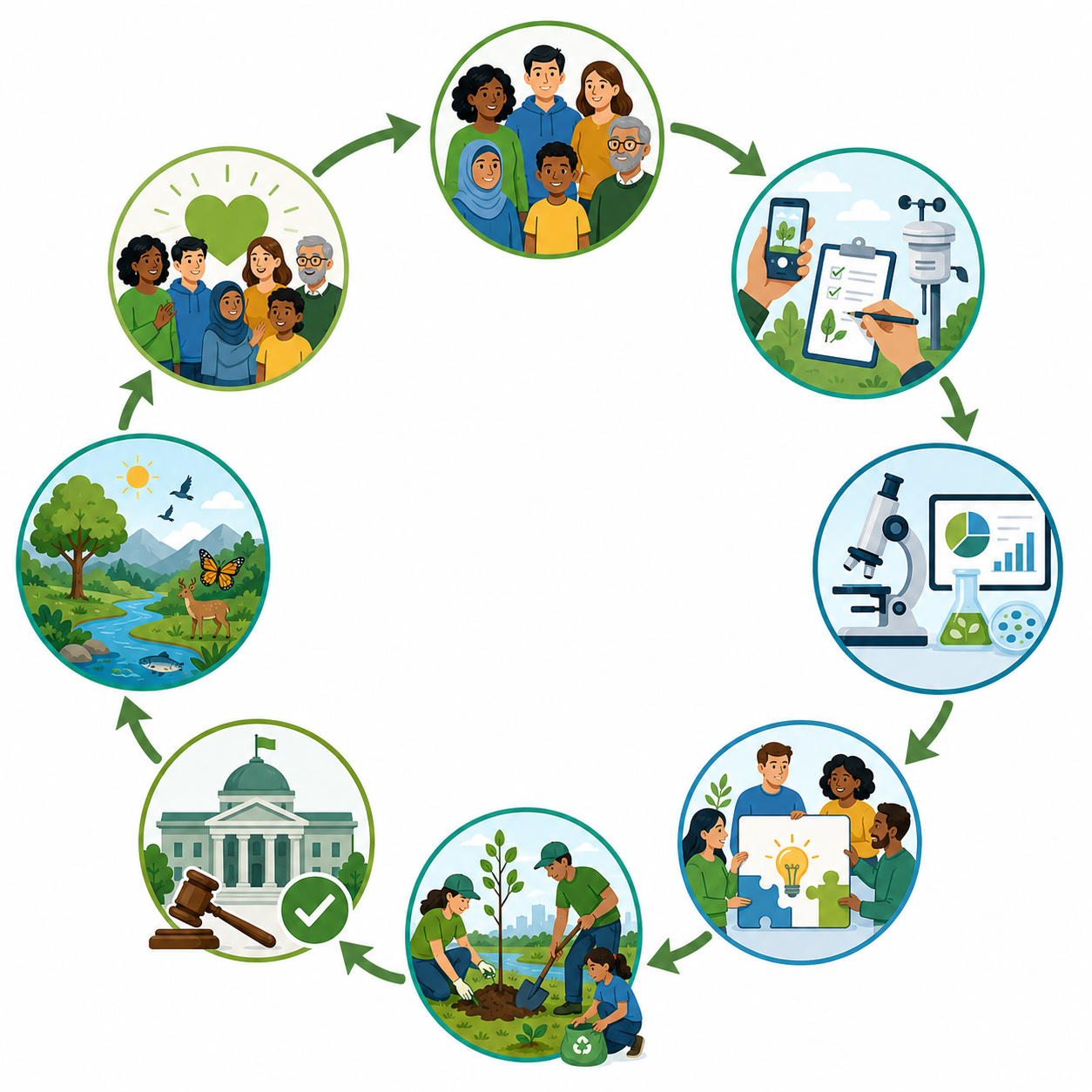
11. Participatory science as a regenerative circle
One of the posters presented during the workshop proposed a circular vision of participatory science.
In this vision, citizens:
enter research;
produce data;
produce results;
transmit to other audiences;
enrich society;
feed scientists;
enable action;
contribute to a regenerative or resilient effect on the environment.
This loop is central. Participatory science is not only a way of "making people participate"; it is a process of reciprocal transformation.
Citizens change because they better understand their territory, their uses, their impacts, and their levers for action.
Scientists change because they gain access to more numerous, more diverse observations, more widely distributed in space and time, and because they must make their methods shareable.
Public policies change because they can rely on locally produced, socially appropriated data made visible by citizens.
The territory changes when observations lead to decisions, restorations, developments, new practices, or preservation policies.
12. Educational symbols: ants, hands, book, territory
The posters produced during the workshop used several strong symbols.
The ants represented collective work, cohesion, shared effort, and the ability to accomplish together what no individual could do alone.
The joining hands represented the capacity to act together, cooperation, the transition from isolated knowledge to collective action.
The multiplication of people represented the increase in the amount of data. The more participants there are, the more observations, records, comparisons, perspectives, and therefore knowledge there can be.
The book or knowledge represented the increase in knowledge, transmission, and understanding.
The political component recalled that participatory science does not stop at producing data: it must be able to reach decision-makers, show what is possible, make local expectations visible, and influence public policies.
These symbols are important because they make the concept accessible. They show that participatory science is at once:
scientific;
educational;
civic;
political;
territorial;
regenerative.
13. The ten key concepts to master
1. Participatory science
Active involvement of citizens in the collection, analysis, interpretation, or use of scientific data. It makes it possible to multiply observations, extend the geographical coverage of research, and raise public awareness of ecological issues.
2. Co-creation of knowledge
A process through which scientists, citizens, local actors, associations, institutions, and decision-makers build knowledge together. It makes it possible to adapt scientific results to local realities.
3. Civic engagement
Active mobilization of people concerned by a territory, environment, problem, or solution. This engagement strengthens the legitimacy of data and promotes appropriation of the issues.
4. Open Science and Open Data
Practices aimed at making methods, data, and results accessible. Openness facilitates the reproduction of studies, transparency, innovation, and coordination of environmental actions.
5. Collective intelligence
A group’s capacity to mobilize different knowledge, experiences, skills, and points of view to solve complex problems. It is decisive in ecological transitions.
6. Environmental crowdsourcing
Mobilization of a large number of people to collect data on environmental phenomena: biodiversity, pollution, climate, water, soils, species, microplastics, air quality.
7. Participatory observation of biodiversity
Citizen contribution to the monitoring of species and ecosystems. It makes it possible to detect declines, appearances, imbalances, or the effects of conservation policies.
8. Environmental education through practice
Learning based on participation in concrete projects. It transforms abstract understanding into skills, experiences, and capacities for action.
9. Social innovation and co-innovation
Association of citizens, researchers, companies, local authorities, and associations to test new ecological solutions: soft mobility, smart waste management, local planning, habitat restoration, digital tools.
10. Participatory ecological transition
Transformation of society in which citizens are not merely informed, but involved in the definition, implementation, and evaluation of ecological strategies.
14. Complete method for designing a participatory science project with impact
14.1. Define the objective
A project must begin with clarification:
do we want to raise awareness?
do we want to produce data?
do we want to train?
do we want to influence a public policy?
do we want to restore an environment?
do we want to change a behavior?
do we want to compare several practices?
do we want to bring forth a solution?
do we want to document an invisible problem?
Without a clear objective, the project risks producing an interesting but scattered activity.
14.2. Identify the audiences
The audiences may be:
children;
adolescents;
families;
students;
residents;
farmers;
fishers;
river residents;
professionals;
associations;
elected officials;
local authorities;
researchers;
hospitals;
companies;
tourism stakeholders;
managers of natural areas.
Each audience has its constraints, motivations, skills, availability, and expectations.
14.3. Analyze the needs
A field study is necessary to understand:
expectations;
limits;
risks;
knowledge already present;
potential conflicts;
logistical constraints;
training needs;
accessibility barriers;
safety issues;
possibilities for moving into action.
14.4. Co-construct the question
A good project does not begin only with a theme. It begins with a clear question.
Bad starting point: "We are going to do a project on water."
Better starting point: "Which impermeable areas in our neighborhood prevent water infiltration and could be transformed into vegetated spaces?"
Bad starting point: "We are going to raise awareness about pesticides."
Better starting point: "How does insect diversity vary according to agricultural practices, and what data can help farmers, students, and decision-makers change practices?"
14.5. Choose the protocol
The protocol must be:
understandable;
robust;
reproducible;
suited to the audience;
simple enough to be used;
rigorous enough to produce useful data;
safe;
inclusive;
compatible with the field.
14.6. Prepare the tools
The tools may include:
observation notebooks;
monitoring calendars;
mobile applications;
maps;
sensors;
suitable scientific traps;
measurement kits;
forms;
collaborative platforms;
open databases;
recordings;
artificial intelligence tools to structure feedback;
monitoring tables;
posters;
mood boards;
educational materials;
impact dashboards.
14.7. Organize the workshops
Workshops can be used to:
brainstorm;
clarify needs;
compare hypotheses;
produce posters;
visualize ideas;
debate disagreements;
test understanding;
prepare field trips;
improve proposals;
bring forth critical questions.
14.8. Deploy in the field
Logistics matter as much as science:
transport;
meals;
equipment;
safety;
authorizations;
weather;
schedules;
accessibility;
support;
group management;
responsibilities;
prior training;
field-trip protocols;
data storage;
reporting back.
The documents show that even apparently peripheral moments, such as a shared meal, a specialty meal, savory or sweet dishes, popcorn, displaying posters, or choosing a team rallying cry, have an educational function: they build the collective.
14.9. Plan feedback
A participatory project must include moments of return:
regular meetings;
reviews;
questionnaires;
discussions;
adjustments;
improvement of protocols;
correction of blind spots;
consideration of disagreements.
Disagreements are not failures. They are often a sign that the subject is rich.
"If it is not easy to synthesize, it may be because the discussion is rich and complex."
14.10. Evaluate impact
Several levels must be distinguished:
impact on knowledge;
impact on participants;
educational impact;
behavioral impact;
scientific impact;
territorial impact;
political impact;
regulatory impact;
direct ecological impact;
long-term ecological impact;
societal or human impact.
A project can be very useful without immediately having a direct ecological impact. But it must be honest about its level of impact.
15. The ingredients of a participatory science project with impact
A participatory science project with impact generally combines the following elements:
1. A real scientific or territorial question
The question must not be decorative. It must make it possible to produce useful knowledge.
2. Real participation
Citizens must not be only extras, test subjects, students, or communication relays.
3. Usable data
Observations must be organized so that they can be analyzed, compared, and used.
4. Clear pedagogy
Participants must understand what they are doing, why they are doing it, and what it can change.
5. Possible action
The data must open up a possibility for action, even if that action is gradual.
6. Political articulation
The project must be able to meet a local authority, a participatory budget, an elected official, a manager, an institution, or a public policy.
7. A leverage effect
The project must seek the points where one action can produce several positive effects.
8. A link between local and global
Local action must be connected to major issues: climate, biodiversity, water, pollution, soils, ocean, SDGs.
9. Continuous evaluation
The project must learn from its mistakes, unexpected events, field feedback, and disagreements.
10. A capacity for transmission
The results must be shareable with other citizens, other territories, scientists, decision-makers, and broader audiences.
16. Complete examples of possible projects
16.1. School trip for ecological awareness-raising
Context:
A school trip is designed to raise students’ awareness of ecological issues while transforming them into actors in research.
Process:
study of the expectations of young people and teachers;
participatory workshops during the stay;
species counting;
field surveys;
reforestation workshops;
use of digital tools;
data collection and analysis;
reporting back in the form of posters or presentations.
Impact:
Students are no longer merely learners. They understand that they can contribute to real research, produce data, and participate in the local transition.
16.2. Citizen project for local transition
Context:
Residents identify local environmental problems: lack of trees, light pollution, waste, heat islands, species disappearance, soil artificialization.
Process:
co-creation meetings;
posters;
maps;
inventories;
participatory budget;
regular monitoring;
dialogue with elected officials;
planning or restoration project.
Impact:
The project strengthens local governance, gives citizens a capacity to act, and can produce concrete public policies.
16.3. Participatory research in a hospital setting
Context:
A hospital, researchers, and citizens work on the links between the urban environment and health: air quality, green spaces, heat, pollution.
Process:
collection of environmental data;
involvement of citizens, patients, or local residents;
recordings;
AI tools to structure the data;
reporting back during a public health forum.
Impact:
The project raises awareness of the links between environment and health, and can support local policies on air quality, green spaces, or urban planning.
16.4. Citizen pollinator observatory
Description:
Citizens observe and report the presence of bees, butterflies, bumblebees, and other pollinators, for example via a mobile application.
Effects:
population monitoring;
detection of declines;
identification of ecological corridors;
awareness-raising on pesticides and habitat fragmentation;
support for local preservation policies.
16.5. eBird
Description:
International bird observation platform used by amateur and professional ornithologists.
Effects:
global database;
migration monitoring;
detection of local declines;
identification of species invasions;
assistance with territorial planning;
citizen contribution to science.
16.6. BioBlitz
Description:
One-off operation during which citizens and experts record, over the course of a day, the animal, plant, or fungal species present in an area.
Effects:
local inventory;
community engagement;
enhancement of local knowledge;
baseline data;
adaptation of management strategies for a natural area.
16.7. Participatory water-quality monitoring
Description:
River residents or nature enthusiasts sample and record data on water quality in rivers, lakes, or wetlands.
Effects:
early detection of pollution;
faster response by authorities;
improvement of resource management;
training citizens in environmental parameters;
collective accountability.
16.8. Biodiversity data platforms
Description:
Collaborative platforms, often run by associations or research organizations, collect data on local fauna, for example birds.
Effects:
long-term monitoring;
evaluation of the effectiveness of conservation measures;
mobilization of researchers, reserve managers, and local authorities;
education and engagement.
16.9. Co-creation in ecological innovation
Description:
Collaborative platforms or projects invite citizens, companies, and researchers to propose and test solutions: soft mobility, smart waste management, reduction of ecological footprint, local planning.
Effects:
shared innovation;
faster adoption of solutions;
local experimentation;
influence on public policies;
possibility of scaling up.
17. Examples from the game: how to strengthen the proposals
Light-up showerhead
To move from a behavioral impact to a more systemic impact, it would be necessary to:
aggregate anonymized data;
identify the buildings or uses that consume the most;
connect measurements to equipment policies;
work with social landlords, schools, local authorities, swimming pools, campsites, or hotels;
compare effects before/after;
integrate the results into water-saving programs.
Biodiversity inventory
To strengthen the impact:
connect observations to planning decisions;
identify key habitats;
propose ecological corridors;
monitor indicator species;
mobilize elected officials;
integrate data into open platforms;
change mowing, lighting, pesticide, or urban-planning practices.
Heat islands
To strengthen the impact:
map temperatures with a shared protocol;
cross-reference with materials, trees, shade, surface coverings;
identify vulnerable groups;
propose greening plans;
monitor the effect of plantings;
integrate the data into urban-planning policies.
Microplastics
To strengthen the impact:
identify sources;
map entry points into the river;
compare data over time;
work with schools, companies, local authorities, and associations;
connect measurement, source reduction, regulation, and awareness-raising;
monitor the effect of changes.
Marine carbon sinks
To strengthen the impact:
involve fishers, divers, scientists, associations, local authorities;
monitor seagrass beds, mangroves, or reefs;
document restoration;
connect biodiversity, carbon, and acidification;
train citizens in ecological monitoring;
include the data in a coastal strategy.
Fine particles
To strengthen the impact:
install citizen sensors;
identify peaks;
compare roads, factories, schools, neighborhoods;
alert decision-makers;
modify traffic plans;
monitor the effects of public measures;
connect health and environment.
Pesticides and insects
To strengthen the impact:
build a protocol with scientists, students, and farmers;
compare several practices;
produce usable data;
connect results, food, and agricultural choices;
discuss alternatives;
report back to farmers, local authorities, and families.
Depaving
To strengthen the impact:
map concrete surfaces;
identify transformable areas;
involve children, parents, neighbors, elected officials;
measure infiltration, temperature, biodiversity;
propose transformations;
mobilize a participatory budget;
monitor effects after works.
18. Educational dimensions not to neglect
The workshops showed that participatory science is not only a scientific method. It is also an educational method.
The following day was to focus on:
instruction;
learning strategies;
psychological aspects;
poster preparation;
construction of the educational pathway;
improvement of activity proposals.
The challenge is to move from a well-intentioned project to a structured educational experience.
Educational questions to ask:
What should participants understand?
What should they know how to do?
What skills will they develop?
What emotions can support engagement?
What risks of cognitive overload?
What visual aids?
What field time?
What debriefing time?
What reporting-back moments?
What records should be kept?
How can trying to include everything be avoided?
How can everyone be enabled to contribute?
Participants were invited to immediately note down two or three important elements to reuse in their projects, in order to avoid forgetting key points after a dense day.
A collaborative rule was also recalled: do not try to include everything, make choices, and avoid nights that are too short when finalizing projects.
19. The importance of conviviality, the collective, and rituals
The documents emphasize elements that may seem secondary, but that are in fact important in a participatory dynamic:
displaying posters in the corridors or outside the room;
placing posters side by side for comparison;
specialty meal in the cafeteria;
materials supplied by the host: dishes, cutting boards, cutlery;
twenty-five minutes to prepare and set up the specialties;
savory and sweet dishes prepared collectively;
popcorn for the evening;
grouping into teams;
choosing a team name;
choosing a rallying cry;
guessing game to energize the group.
These rituals build cohesion. They give the group the energy needed to work through disagreements, complexity, fatigue, and production requirements.
In participatory science, the quality of relationships is not an add-on. It conditions the quality of the collective work.
20. Difficulties encountered and proposed responses
20.1. Difficulty synthesizing
Participants had difficulty summarizing their exchanges on the role of participatory science in the ecological transition.
Response:
This difficulty was interpreted as a sign of a rich and complex discussion. It was proposed to focus on the points that had generated the most debate, for example the difference between conventional science and participatory science.
20.2. Risk of forgetting important elements
With a busy program, participants risked forgetting useful ideas.
Response:
Immediately take two or three notes on the elements to integrate into the final projects.
20.3. Time management
Participants had to finalize their projects for a later presentation, with a risk of working too late.
Response:
Make choices, do not include everything, respect a work limit, aim for a clear rather than exhaustive production.
20.4. Distinguishing direct impact from systemic impact
Participants sometimes confused useful action, educational action, action on symptoms, and action on causes.
Response:
Use simple examples: smoke/fire, migration/causes of migration, water consumption/behaviors and infrastructure.
20.5. Global/local bias
The group identified the risk of responding to planetary crises with overly limited local actions.
Response:
Think in networks of local actions, connect projects to public policies, avoid depoliticizing the issues.
20.6. Confusion between scientific education and participatory science
A proposal involving students was questioned: was it an educational activity or a true participatory project?
Response:
Clarify that citizens must contribute to research, decisions, analysis, and communication, and not merely learn.
20.7. Information overload
Some participants experienced cognitive overload.
Response:
Provide more practical time, especially in the field, and better sequence learning.
20.8. Safety and responsibility
Concerns were expressed about field trips.
Response:
Provide systematic support by experienced people, safety protocols, prior training, and avoid sending participants alone into sensitive terrains.
20.9. Accessibility and disability
One participant raised the question of the accessibility of activities.
Response:
Integrate accessibility from the design stage of projects: choice of terrain, materials, pace, instructions, tools, support, alternatives.
21. Safety, fieldwork, and responsibility
Participatory science can lead to field trips: rivers, forests, coastlines, urban neighborhoods, fields, wetlands, natural areas, measurement sites. These outings require rigorous preparation.
To plan:
preliminary reconnaissance;
support from people familiar with the region or study;
training in instructions;
safety protocol;
appropriate equipment;
emergency contacts;
group management;
authorizations;
accessibility;
attention to weather conditions;
training in respect for environments;
instructions such as "leave no trace."
The question is not only: how can data be collected? It is also: how can people be enabled to contribute without putting them in difficulty, degrading the environment, creating risk, or producing poorly controlled responsibility?
22. Accessibility: a condition for real participation
A participatory project cannot claim to be open if some people are de facto excluded by the terrain, tools, pace, materials, or instructions.
Accessibility must be considered at several levels:
physical accessibility of places;
cognitive accessibility of instructions;
sensory accessibility of materials;
digital accessibility of platforms;
social and financial accessibility;
adaptation to visible and invisible disabilities;
possibilities for remote participation;
different roles according to capacities;
valuing diverse contributions.
A person who cannot walk for a long time can contribute to analysis, mapping, data entry, reporting back, communication, comparison, or governance. A person who cannot use an application can contribute through a paper notebook. A person who cannot go into the field can participate in preparation or interpretation.
Real participation requires diversifying forms of contribution.
23. Participatory science, impact, and temporalities
Not all impacts occur at the same pace.
Immediate impact:
awareness;
learning;
observation;
data collection;
mobilization;
alert.
Direct impact:
preventing degradation;
restoring an area;
modifying a development;
changing a practice;
getting a local project adopted.
Medium-term impact:
enriching a database;
influencing a local plan;
changing behaviors;
monitoring the evolution of an environment;
structuring a community of action.
Long-term impact:
changing the relationship with nature;
developing a non-anthropocentric vision;
transforming public policies;
changing social norms;
contributing to a shared ecological culture.
One example was discussed: preventing a highway from crossing a sensitive area constitutes a direct impact. Gradually increasing the protected surface area is a medium-term impact. Transforming humanity’s relationship with nature, by moving beyond a strictly anthropocentric vision, belongs to a deeper and longer-term impact.
Participatory science can therefore produce visible and immediate impacts, but also slow, cultural, and fundamental transformations.
24. Participatory science and Sustainable Development Goals
Projects can also be connected to the Sustainable Development Goals, for example:
access to water;
access to food;
health;
education;
sustainable cities;
climate;
life on land;
life below water;
reduced inequalities;
partnerships.
However, artificial links must be avoided. A project on an environmental probe does not automatically address access to food. But a project on pesticides, agriculture, insects, food practices, and soils can be connected to health, food, biodiversity, water, and the transformation of agricultural practices.
The right question remains: what real link is there between the data produced, the possible action, and the targeted objective?
25. The posture to favor: learning good habits
One of the strong educational contributions concerns how to support behavioral change.
Telling people what they must stop doing may work in the short term, but it often provokes resistance, guilt, or fatigue.
The example given concerned meat consumption and emissions related to livestock farming. Saying "stop eating meat" can lead to a temporary effort. Proposing an appealing recipe based on lentils, chickpeas, or plant proteins can, on the contrary, gradually establish a new habit.
"To change mindsets, we do not fight against bad habits: we learn good ones."
This logic is important for participatory science. It must avoid being limited to ecological anxiety or moral injunction. On the contrary, it can make people want to act by making solutions concrete, desirable, testable, and shareable.
Example:
Instead of saying: "Reduce your water consumption."
Propose: "Let’s test together a device that shows your consumption in real time and compare the effects over one week."
Example:
Instead of saying: "Biodiversity is disappearing."
Propose: "Let’s discover which species still live here, which ones are declining, and which local actions can help them."
Example:
Instead of saying: "Soils are too artificialized."
Propose: "Let’s map the surfaces that could become permeable again and transform a schoolyard into a cool island."
26. Digital tools, AI, and collaborative platforms
The documents mention the importance of modern tools for structuring projects:
artificial intelligence;
recordings;
collaborative platforms;
digital collection tools;
mobile applications;
databases;
visualizations;
communication materials;
tools for structuring action plans or business models.
These tools do not replace the method. They strengthen it if their role is clear.
They can be used to:
collect observations;
organize data;
detect trends;
facilitate communication between actors;
produce syntheses;
preserve the memory of workshops;
help write statements or position papers;
structure projects;
prepare reporting back;
monitor indicators.
But they must remain at the service of the project, and not become the project themselves.
27. Posters as a tool for collective thinking
Posters are not only presentation materials. They are clarification tools.
They require groups to:
choose the important ideas;
organize thinking;
make a logic visible;
represent relationships between actors;
integrate symbols;
discuss disagreements;
prepare a report-back;
receive comments.
During the workshop, the posters helped bring forth:
collective work;
capacity to act;
multiplication of data;
the political role;
circularity between citizens, scientists, and society;
the expected regenerative effect.
They also revealed a difficulty: synthesizing participatory science is complex, because it is at once a scientific method, pedagogy, citizen mobilization, a political tool, and a lever for ecological transformation.
28. Proposed analysis grid for a project
Question 1 - Is the problem well formulated?
Does the project respond to a precise, observable, situated ecological difficulty?
Question 2 - Is the scientific question clear?
Do we know what we are trying to know, measure, compare, or understand?
Question 3 - Do participants have a real role?
Are they only informed, or do they participate in the research?
Question 4 - Are the data useful?
Can they be used by researchers, local authorities, citizens, or decision-makers?
Question 5 - Does the project act on symptoms or causes?
Does it only reduce a visible effect, or does it transform the mechanisms that produce the problem?
Question 6 - What is the leverage effect?
Can one action lead to other positive effects?
Question 7 - What decision can follow?
Can the project lead to a policy, a participatory budget, a restoration, a rule, a change in practice?
Question 8 - Is the project accessible?
Can people with disabilities, excluded audiences, children, and non-specialists contribute?
Question 9 - Is the project safe?
Are field trips, handling, tools, and responsibilities controlled?
Question 10 - How will the impact be monitored?
Will there be indicators, reviews, before/after comparisons, feedback?
29. Proposed operational canvas
Project title:
Clear, understandable, mobilizing name.
Planetary boundary or ecological issue concerned:
Climate, biodiversity, water, pollution, ocean, soils, environmental health, etc.
Observed local problem:
Concrete and territorialized formulation.
Research question:
What the project truly wants to know.
Participants:
Citizens, students, residents, professionals, researchers, elected officials, associations.
Role of participants:
Observation, measurement, protocol, analysis, decision, action, reporting back.
Method:
Protocol, tools, frequency, places, data.
Educational dimension:
What participants learn and experience.
Scientific dimension:
What the data make it possible to produce.
Political dimension:
Who can decide or act thanks to the results?
Expected impact:
Knowledge, behavior, local action, public policy, restoration.
Level of impact:
No impact, symptom, direct cause, systemic transformation.
Leverage effect:
What other issues can be improved by this action?
Safety:
Risks, support, authorizations, training.
Accessibility:
Planned adaptations.
Reporting back:
Poster, map, report, public meeting, platform, debate with elected officials.
Monitoring:
Indicators, reviews, feedback, continuous improvement.
30. Four practical exercises for training a group
Exercise 1 - Co-creation workshop
Organize a brainstorming session with posters and mood boards. Participants define the ecological needs of their territory, visible problems, missing data, and possible actions.
Objective: bring forth local and adapted solutions.
Exercise 2 - Participatory market study
Conduct a survey among students, citizens, professionals, associations, residents, or local authorities to identify priority ecological challenges and expectations for intervention.
Objective: build a social and territorial database to guide projects.
Exercise 3 - Local pilot project
Test a data collection initiative: biodiversity, air quality, water quality, heat islands, soils, microplastics.
Objective: evaluate impact, adjust the protocol, and prepare scaling up.
Exercise 4 - Collaborative feedback
Set up debriefing meetings, questionnaires, reviews, and feedback.
Objective: continuously improve the project and ensure its adaptation.
31. From fundamental research to impact: do not confuse everything
It is possible to do participatory science without seeking direct ecological impact. Some participatory research belongs to fundamental research, pure knowledge, understanding a phenomenon, or scientific education. It has value.
But when speaking of ecological transition, the ambition must be clarified.
Three levels can coexist:
1. Knowledge-based participatory science
It produces data and improves understanding.
2. Educational participatory science
It transforms participants, their skills, and their relationship with the world.
3. Participatory science with impact
It produces data, transforms participants, and enables an action or decision that changes the ecological, social, or political situation.
One of the objectives of the workshops was precisely to identify the ingredients needed to move from the first or second level toward the third.
32. Toward a common position paper
The exchanges were recorded in order to produce a position paper, or statement, representing the different points of view expressed. This approach is consistent with the spirit of participatory science: it is not only a matter of producing a report, but of bringing forth a collective position nourished by debates, disagreements, proposals, and feedback.
Such a position paper could state that:
participatory science is a major lever for ecological transitions;
it must be distinguished from simple awareness-raising;
it must articulate science, pedagogy, citizenship, and action;
it must aim for measurable effects, while also recognizing long-term impacts;
it must be designed with methodological rigor;
it must integrate safety, accessibility, and inclusion;
it must connect local actions and public policies;
it must avoid being limited to symptoms;
it must seek causes, leverage effects, and systemic transformations.
33. Conclusion: making the ecological transition a common project
Participatory science makes it possible to transform the ecological transition into a common project. It does not merely ask citizens to "do their part"; it gives them the means to understand, measure, discuss, decide, experiment, transmit, and act.
It enriches scientific research through the multiplication of observations and the diversity of field sites. It enriches citizens through direct experience of research. It enriches public policies through local, legitimate, and appropriated data. It enriches territories through actions better adjusted to local realities.
But its power depends on its rigor. A participatory project does not automatically become transformative. It must be designed rigorously, connected to a clear question, open to real participation, attentive to root causes, connected to decisions, evaluated over time, safe, accessible, and capable of learning from its own limits.
"Participatory science can be done without impact. The issue here is to understand how participatory science can become participatory science with impact."
The ecological transition needs knowledge. It needs decisions. It needs public policies. It needs economic changes. It needs cultural transformations. But it also needs spaces where citizens are no longer merely spectators of the crisis or recipients of instructions: they become co-researchers, co-decision-makers, co-actors, and co-responsible for a more resilient, more regenerative, and more habitable future.
Suggested final illustration: large fresco showing a territory before/after: mineral street turned into tree-lined street, river monitored by citizens, vegetated school, air-quality sensors, species inventory, elected officials gathered around a map, researchers and residents analyzing data together.
Appendix 1 - Control questions before launching a project
Is the ecological problem clearly identified?
Is the planetary boundary or transition issue explicit?
Does the project respond to a real local need?
Are participants merely made aware or truly involved?
Is the research question understandable?
Is the protocol robust?
Will the data be usable?
Can the results be shared?
Does the project act on a symptom or a cause?
Has the leverage effect been identified?
Can concrete action follow?
Can a local authority, elected official, association, or institution use the results?
Is a participatory budget or another local funding source possible?
Are field risks controlled?
Can people with disabilities participate?
Are the educational materials adapted?
Do participants understand why they are contributing?
Will the results be reported back?
Will the impact be evaluated?
Can the project be reproduced elsewhere?
Appendix 2 - Mini-glossary
Key action
A limited but strategic action, whose effect opens up a next step or triggers other transformations.
Leverage effect
The capacity of an action to produce positive effects beyond its immediate objective.
Direct impact
Visible or measurable effect on a given situation.
Systemic impact
Effect that acts on the root causes, rules, behaviors, infrastructure, or decisions that produce the problem.
Participatory science
Scientific approach actively involving citizens or non-professional actors in the production of knowledge.
Participatory ecological transition
Ecological transformation built with citizens, and not only for them.
Symptom
Visible effect of a problem.
Cause
Mechanism that produces the symptom.
Regenerative
Which does not merely reduce damage, but contributes to restoring environments, connections, capacities, or balances.
Coopetition
Dynamic in which several teams all seek to succeed together, while maintaining a strong requirement in the evaluation of proposals.
Participatory budget
Public mechanism allowing citizens to propose and sometimes choose projects funded by a local authority.
Open Data
Data made accessible in order to allow their reuse, verification, and dissemination.
Environmental crowdsourcing
Large-scale collection of environmental information through the participation of a large number of people.
Appendix 3 - Key message to remember
Participatory science is not only a way to make people like science or raise ecological awareness. It can become a method for transforming territories.
Provided that it meets three requirements:
1. A scientific requirement
Produce reliable, useful, analyzable, and shareable data.
2. A democratic requirement
Enable citizens to truly participate in research, choices, and interpretation.
3. An impact requirement
Connect the knowledge produced to actions, decisions, public policies, or changes in practices.
It is in this articulation between science, citizenship, pedagogy, and action that participatory science can support, generate, and accelerate ecological transitions.