
What is a “challenge”?
A challenge given to hackathon participants is a concrete issue faced by your organization for which you want to explore a new solution.
It can, for example, relate to data collection, awareness-raising, education, biodiversity, tourism, citizen mobilization, or the design of a participatory science initiative.
The challenge does not need to be framed as an already-defined solution. On the contrary, the idea is to give participants enough context to understand your need and leave them free to imagine different answers.
To submit a challenge, you simply need to specify:
- The problem or issue your organization is facing;
- Why this issue matters for your activity or your territory;
- What you would like to be able to do or obtain at the end of the Hackathon;
- Any existing constraints or resources to take into account;
- The people, audiences or stakeholders who could be affected by the future project.

For five days, your challenge becomes a project
Once the challenges have been presented, participants can choose the issues they would like to contribute to.
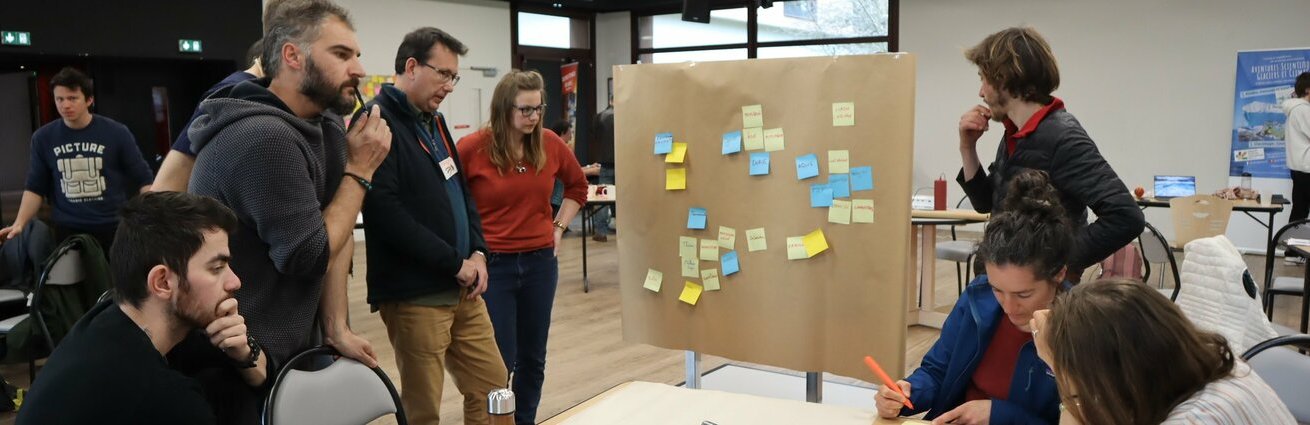
For five days, they work as a team, supported by mentors and resource persons, to turn the challenge into a participatory science project.
The project is built up step by step, taking into account several dimensions: its value for the territory, the audiences to mobilize, the ways of participating, the resources required and the conditions needed to carry it out.
The aim is therefore not simply to produce an idea, but to move forward a project that your organization could potentially take over after the Hackathon.
What does your organization get?
At the end of the five days, organizations that submitted a challenge can take away a participatory science project built around their issue.
The project is designed to be continued or adapted after the Hackathon, in particular by the organization behind the challenge or by other interested stakeholders.
The final showcase allows the projects to be presented to funders, organizations able to implement them, and stakeholders who can contribute to their development.
This event also makes it possible to identify shared interests between project leaders and the organizations that could support or take over the projects.
A showcase that looks beyond the idea
The technical aspects of the scientific project are addressed after the hackathon with research partners. The hackathon focuses primarily on educational design and the economic model (free access, contribution to costs, grants, etc.). For these reasons, the final evaluation of the projects at the showcase will pay particular attention to the project’s scope and its ability to become a concrete action:
Educational approach
Does the project genuinely make it possible to involve different audiences in a participatory science approach?
Feasibility
Can the project be implemented under realistic conditions? Is it simple and user-friendly enough to be run and used in the field?
Economic model
What could the operating arrangements of the project be: free access, participant contributions, volunteering, funding or another model?
These elements make it possible to better assess the conditions needed for the project to continue after the Hackathon.
